
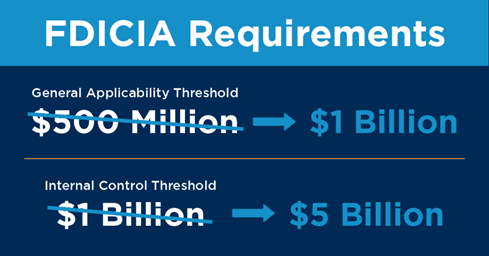
The FDIC’s final rule updating FDICIA Part 363 thresholds is now in effect, and for many community and regional banks, it represents meaningful regulatory relief. Asset thresholds for annual audits, internal control attestations, and audit committee requirements have increased and will now be indexed for inflation going forward.
But relief does not equal retreat. For boards and executive teams, this is a moment for intentional recalibration, not autopilot.
Here are several actions banks should be taking now:
Reassess (Not Abandon) Your Control Environment
While institutions under the new thresholds may no longer be required to perform certain ICFR attestations or enhanced audit procedures, strong internal controls remain foundational to safety and soundness. Boards should deliberately decide which elements of their current framework remain appropriate based on risk profile—not regulation alone.
Revisit Audit & Assurance Strategy
Management and audit committees should evaluate whether to maintain certain assurance activities voluntarily, particularly for institutions approaching future thresholds or pursuing growth, M&A, or capital strategies. The question is no longer “What does FDICIA require?” but “What level of assurance best supports our strategy?”.
Update Board & Audit Committee Governance Expectations
With higher thresholds for audit committee composition and independence requirements, boards should confirm their governance structure still aligns with stakeholder expectations, examiner posture, and complexity, even if prescriptive requirements have eased.
Educate the Board on What Changed—& What Didn’t
This is a governance moment. Boards should receive a clear briefing on:
- Which FDICIA requirements no longer apply
- Which remain in force
- How management proposes to adjust (or maintain) oversight accordingly
This ensures changes are intentional, documented, and defensible.
Plan Ahead for Indexed Thresholds
Automatic inflation indexing means thresholds will move again. Institutions hovering near $1B or $5B should model future growth scenarios now, so future compliance isn’t reactive or disruptive.
Key Takeaways
FDICIA 363 reform provides flexibility, but it also requires informed judgment. The Bonadio Group’s banking and regulatory professionals work with boards and management teams to evaluate governance, controls, and assurance strategies in light of these changes. If you have not yet had this conversation, we welcome the opportunity to connect. Please do not hesitate to reach out to discuss your specific situation.
This material has been prepared for general, informational purposes only and is not intended to provide, and should not be relied on for, tax, legal or accounting advice. Should you require any such advice, please contact us directly. The information contained herein does not create, and your review or use of the information does not constitute, an accountant-client relationship.